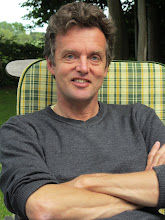
MY MOTHER-IN-LAW
It's my mother-in-law's birthday today, so congratulations to her. That's also why I am not blogging today; I have been to her house for tea and dinner. Apart from this, of course.
Walter Blotscher
Friday, 30 November 2012


Thursday, 29 November 2012
THE 2012 PROJECT (4)
There is nothing quite like the feeling you get when you apply a chainsaw with a brand new chain to a large tree trunk, it's like a knife going through butter. The metal is quite soft, so it loses its sharpness after a while. But I was still able to do some serious chopping this morning.
With the onset of winter, it's time to do some more work on the 2012 Project, licking the orchard into shape.We had also run out of wood for the stove, and my wife was beginning to nag me. As well as an annoying sycamore that was encroaching from the wood, I chopped down the two pear trees which I had left earlier this year. I have cut them right down to just above ground level, and hope that they will begin to recover next year in the same way as my resilient apple tree has done next to the house. After lugging the lumps of trunk into the barn, I went to work with my axe. There's now a fair stack of wood, that should last us until Christmas, and a pleasant tiredness in my shoulder muscles.
I inherited the Husqvarna chainsaw, plus the padded safety overalls and helmet with mesh visor, from my father-in-law, who had purchased it just before he died. Since then, I have not only used it a lot, but have learned how to maintain it, clean it, oil it, and change the chain (major achievements, given my lack of practical skills pre-2000). It wasn't starting well this week, and I thought it might be because I am not strong enough any more. However, when I took it yesterday to the local shop that helps me in these matters, the mechanic took the top off and immediately said "you're missing a spring". Without the two springs attached to the rotor, you can apparently tug on the rope handle from now until next year, and still not get it started. You learn something every day.
Two new springs and a chain later, and I was all set. I am not a weedy forester after all.
Walter Blotscher
There is nothing quite like the feeling you get when you apply a chainsaw with a brand new chain to a large tree trunk, it's like a knife going through butter. The metal is quite soft, so it loses its sharpness after a while. But I was still able to do some serious chopping this morning.
With the onset of winter, it's time to do some more work on the 2012 Project, licking the orchard into shape.We had also run out of wood for the stove, and my wife was beginning to nag me. As well as an annoying sycamore that was encroaching from the wood, I chopped down the two pear trees which I had left earlier this year. I have cut them right down to just above ground level, and hope that they will begin to recover next year in the same way as my resilient apple tree has done next to the house. After lugging the lumps of trunk into the barn, I went to work with my axe. There's now a fair stack of wood, that should last us until Christmas, and a pleasant tiredness in my shoulder muscles.
I inherited the Husqvarna chainsaw, plus the padded safety overalls and helmet with mesh visor, from my father-in-law, who had purchased it just before he died. Since then, I have not only used it a lot, but have learned how to maintain it, clean it, oil it, and change the chain (major achievements, given my lack of practical skills pre-2000). It wasn't starting well this week, and I thought it might be because I am not strong enough any more. However, when I took it yesterday to the local shop that helps me in these matters, the mechanic took the top off and immediately said "you're missing a spring". Without the two springs attached to the rotor, you can apparently tug on the rope handle from now until next year, and still not get it started. You learn something every day.
Two new springs and a chain later, and I was all set. I am not a weedy forester after all.
Walter Blotscher
Wednesday, 28 November 2012
DEFENCE SPENDING
If building a new airport brings out the most Nimby-ish (not in my backyard) tendencies in folk, then defence spending must represent the other end of the spectrum. Nobody wants to give it up, as events in Denmark are demonstrating.
The combination of the end of the Cold War, the collapse of communism, and budget constraints are forcing all rich, developed, nations to review the amount they spend on defence. Modern threats require more intelligence, fewer "boots on the ground", and more cooperation, both between individual services jealous of their turf and traditions, and between nations. Denmark is no exception to these trends.
Earlier this year, the politicians in Copenhagen agreed to cut Dkr.2.7 billion from the defence budget in order to reduce the tax burden on businesses. That was the easy part; the problems come in deciding what to cut and where. Abolishing værnepligt, a sacred cow to those on the right, is difficult to oppose when more than enough young men are volunteering anyway. But the real deal-breaker is closing barracks.
Army bases provide lots of employment, often in out-in-the-sticks places that don't provide many alternative jobs. So as soon as any closure proposals leak out, up pops a local mayor on the news to tell the nation that closing this or that base would be a catastrophe for the local economy and society. These mayors cover the whole political spectrum from left to right, so there are no easy answers, particularly when the current Government is a coalition with a bare majority (defence spending has a tradition of being agreed "across the aisle"). Indeed, some of the national politicians, while agreeing to the cuts in principle, feel unable to support the details because they represent a constituency that (yes, you guessed it) has an army base in it that may get closed.
Not an easy problem to solve. How the Government tackles it will affect in large part the local elections due next autumn. Denmark is a decentralised state, where local councils have real power, so national decisions that adversely affect local interests will almost certainly get punished.
Walter Blotscher
If building a new airport brings out the most Nimby-ish (not in my backyard) tendencies in folk, then defence spending must represent the other end of the spectrum. Nobody wants to give it up, as events in Denmark are demonstrating.
The combination of the end of the Cold War, the collapse of communism, and budget constraints are forcing all rich, developed, nations to review the amount they spend on defence. Modern threats require more intelligence, fewer "boots on the ground", and more cooperation, both between individual services jealous of their turf and traditions, and between nations. Denmark is no exception to these trends.
Earlier this year, the politicians in Copenhagen agreed to cut Dkr.2.7 billion from the defence budget in order to reduce the tax burden on businesses. That was the easy part; the problems come in deciding what to cut and where. Abolishing værnepligt, a sacred cow to those on the right, is difficult to oppose when more than enough young men are volunteering anyway. But the real deal-breaker is closing barracks.
Army bases provide lots of employment, often in out-in-the-sticks places that don't provide many alternative jobs. So as soon as any closure proposals leak out, up pops a local mayor on the news to tell the nation that closing this or that base would be a catastrophe for the local economy and society. These mayors cover the whole political spectrum from left to right, so there are no easy answers, particularly when the current Government is a coalition with a bare majority (defence spending has a tradition of being agreed "across the aisle"). Indeed, some of the national politicians, while agreeing to the cuts in principle, feel unable to support the details because they represent a constituency that (yes, you guessed it) has an army base in it that may get closed.
Not an easy problem to solve. How the Government tackles it will affect in large part the local elections due next autumn. Denmark is a decentralised state, where local councils have real power, so national decisions that adversely affect local interests will almost certainly get punished.
Walter Blotscher
Tuesday, 27 November 2012
RELATIVITY
This is going to surprise some people, but Albert Einstein was not really a very good mathematician. Sure, he was good with numbers. But he was not in the same league as (say) Euler, Gauss, Cauchy or Riemann. The Swiss-born Euler, who was headhunted to be director of the Russian Imperial Academy in the eighteenth century at the vast salary of 3,000 roubles, was so prolific that the official Russian scientific journal was still publishing the backlog of his 886 original mathematical works some forty five years after his death. Einstein's special theory of relativity, on the other hand, used equations called the Lorentz transformation that had already been worked out by someone else, namely the Dutch physicist Hendrik Lorentz.
Does that mean that Einstein wasn't a genius? On the contrary, he was. But not for the reason people commonly suppose.
At the end of the nineteenth century, Newtonian mechanics had reigned for 300 years. I stand on a hill and watch a train go past at 100 km/hour. A man on the train walks forward through the coaches at 5 km/hour. I say that relative to me, the man is travelling at 105 (100 + 5) km/hour. What is more, if I were an observer on the train itself, I would come up with the same answer.
Newtonian mechanics had since expanded to include the new field of electromagnetism, encompassed in the equations of James Clerk Maxwell in 1864. But then came the scientific bombshell of the Michelson-Morley experiment in 1887. Boiling this down to its essentials, this showed definitively that the speed of light was the same in all frames of reference. To use the train analogy, the speed of light for the man on the hill would not be the speed of light on the train plus an extra 5 km/hour, it would remain unchanged.
Mathematicians got to work, and Lorentz soon quantified the effect. But nobody could work out why there was an effect. Most people agreed that it was due to the ether, something in the air that affected light in some way. It took Einstein to show them that they were wrong.
His great insight - which in many ways is more philosophical than mathematical - was to say that the units were different. What is a meter to the man on the hill is not a meter to the man on the train; and what is a second to the man on the hill is not a second to the man on the train. In other words, there are no Newtonian absolutes, how we measure things depends on where we are. For speeds that are small relative to the speed of light, the differences are tiny, infinitessimal even (the Lorentz transformations use a factor equal to the square root of (1- v^2/c^2), so for ordinary measurements like the speed of the train, the factor is essentially 1). But as and when velocities start getting up towards the speed of light, the effects start to become large. And the speed of light, c, is constant in all frames of reference, because it is c train meters/train seconds, and that is the same as c hill meters/hill seconds.
It takes a genius to overturn, or at least expand, a scientific paradigm. Freed from thinking in purely Newtonian terms, it allowed scientists to move on from looking at what happens when things move really fast to looking at what happens when things get really small (which is what quantum theory is all about). Relativity and quantum theory have never been reconciled, though the hope of Einstein and many others was that they are both part of an even larger idea. He never managed to prove that, though he did enough in my view to justify his huge reputation.
Walter Blotscher
This is going to surprise some people, but Albert Einstein was not really a very good mathematician. Sure, he was good with numbers. But he was not in the same league as (say) Euler, Gauss, Cauchy or Riemann. The Swiss-born Euler, who was headhunted to be director of the Russian Imperial Academy in the eighteenth century at the vast salary of 3,000 roubles, was so prolific that the official Russian scientific journal was still publishing the backlog of his 886 original mathematical works some forty five years after his death. Einstein's special theory of relativity, on the other hand, used equations called the Lorentz transformation that had already been worked out by someone else, namely the Dutch physicist Hendrik Lorentz.
Does that mean that Einstein wasn't a genius? On the contrary, he was. But not for the reason people commonly suppose.
At the end of the nineteenth century, Newtonian mechanics had reigned for 300 years. I stand on a hill and watch a train go past at 100 km/hour. A man on the train walks forward through the coaches at 5 km/hour. I say that relative to me, the man is travelling at 105 (100 + 5) km/hour. What is more, if I were an observer on the train itself, I would come up with the same answer.
Newtonian mechanics had since expanded to include the new field of electromagnetism, encompassed in the equations of James Clerk Maxwell in 1864. But then came the scientific bombshell of the Michelson-Morley experiment in 1887. Boiling this down to its essentials, this showed definitively that the speed of light was the same in all frames of reference. To use the train analogy, the speed of light for the man on the hill would not be the speed of light on the train plus an extra 5 km/hour, it would remain unchanged.
Mathematicians got to work, and Lorentz soon quantified the effect. But nobody could work out why there was an effect. Most people agreed that it was due to the ether, something in the air that affected light in some way. It took Einstein to show them that they were wrong.
His great insight - which in many ways is more philosophical than mathematical - was to say that the units were different. What is a meter to the man on the hill is not a meter to the man on the train; and what is a second to the man on the hill is not a second to the man on the train. In other words, there are no Newtonian absolutes, how we measure things depends on where we are. For speeds that are small relative to the speed of light, the differences are tiny, infinitessimal even (the Lorentz transformations use a factor equal to the square root of (1- v^2/c^2), so for ordinary measurements like the speed of the train, the factor is essentially 1). But as and when velocities start getting up towards the speed of light, the effects start to become large. And the speed of light, c, is constant in all frames of reference, because it is c train meters/train seconds, and that is the same as c hill meters/hill seconds.
It takes a genius to overturn, or at least expand, a scientific paradigm. Freed from thinking in purely Newtonian terms, it allowed scientists to move on from looking at what happens when things move really fast to looking at what happens when things get really small (which is what quantum theory is all about). Relativity and quantum theory have never been reconciled, though the hope of Einstein and many others was that they are both part of an even larger idea. He never managed to prove that, though he did enough in my view to justify his huge reputation.
Walter Blotscher
Monday, 26 November 2012
AUTUMN TASKS (2)
Like last year, November was unusually dry this year, so I have done a lot of autumn tasks. Starting with leaves. Being next to a wood, and having a huge beech tree right next to the house, an awful lot of them fall on the house, the yard and the lawns. Sweeping up leaves is a bit like mowing the lawn; a repetitive task that gives plenty of time for introspection.
But I have also been productive. I finished a new terrace (pictures later), and have rendered the foundation on the third side of the barn. I have also built a new rose garden at the front of the house. My mother-in-law thought that the original one round the back was too close to the wood, and that the plants would not get enough sun. That was a correct decision, so last week we dug them up and moved them to their new home.
I also trimmed the beech hedge. As part of that, I discovered a mole that was going berserk under it. I don't mind that, just so long as he doesn't move out and destroy my lawns. After letting him have fun for a week or so, I got tired of the sport, and bagged him in my trap. God, I'm good at mole-hunting.
All that remains is for me to clear out the leaves from the guttering. My daughter has agreed to hold the ladder while I do that on Saturday morning. Then we will be all set for the winter, which is coming next week.
Walter Blotscher
Like last year, November was unusually dry this year, so I have done a lot of autumn tasks. Starting with leaves. Being next to a wood, and having a huge beech tree right next to the house, an awful lot of them fall on the house, the yard and the lawns. Sweeping up leaves is a bit like mowing the lawn; a repetitive task that gives plenty of time for introspection.
But I have also been productive. I finished a new terrace (pictures later), and have rendered the foundation on the third side of the barn. I have also built a new rose garden at the front of the house. My mother-in-law thought that the original one round the back was too close to the wood, and that the plants would not get enough sun. That was a correct decision, so last week we dug them up and moved them to their new home.
I also trimmed the beech hedge. As part of that, I discovered a mole that was going berserk under it. I don't mind that, just so long as he doesn't move out and destroy my lawns. After letting him have fun for a week or so, I got tired of the sport, and bagged him in my trap. God, I'm good at mole-hunting.
All that remains is for me to clear out the leaves from the guttering. My daughter has agreed to hold the ladder while I do that on Saturday morning. Then we will be all set for the winter, which is coming next week.
Walter Blotscher
Sunday, 25 November 2012
THE E.U. BUDGET (2)
I predicted last month that this week's summit to agree the 2014-20 framework for the E.U.'s budget would end in gridlock. That duly happened; after a two day dialogue of the deaf, everybody agreed to go home and try again in the new year.
My prediction, though correct, was not particularly insightful. Because the underlying problem is that Member States disagree hugely about what the E.U. Budget is for. For countries such as the U.K., it's a waste of money that should be kept as small as possible. For the new club members from Eastern Europe, it's a way of reducing the income differentials vis a vis the earlier fifteen. For southerners with lots of farmers, it's an important source of funding, now that domestic budgets are being squeezed. For federalists, it provides useful transnational funding for research and education. And so on and so forth.
These differences have always existed. But with 27 Member States and the European Parliament all having a veto, the permutations and complications have become increasingly complex. Before the last 7-year framework, the Germans, in a spirit of compromise, threw in an extra Euro1 billion at the last minute in order to get an agreement. Now nobody has Euro1 billion to spare, and they would not be inclined to offer it up, even if they had.
It is not easy to see how this one will pan out. It could be that everyone is just posturing before accepting an unpalatable outcome. Personally I doubt it. To take but one example. Denmark's demand for a rebate of Dkr.1 billion (a figure calculated from its Dkr.800 million contribution to the U.K. rebate plus Dkr.200 million to the other rich countries' rebates) has already been factored in to the Government's long-term financing plans, and sold to the Danish electorate as such (i.e. in the bag). Other Governments face equally restive Parliaments and/or electorates. Against that background, the budget negotiations could well run for some time yet.
Walter Blotscher
I predicted last month that this week's summit to agree the 2014-20 framework for the E.U.'s budget would end in gridlock. That duly happened; after a two day dialogue of the deaf, everybody agreed to go home and try again in the new year.
My prediction, though correct, was not particularly insightful. Because the underlying problem is that Member States disagree hugely about what the E.U. Budget is for. For countries such as the U.K., it's a waste of money that should be kept as small as possible. For the new club members from Eastern Europe, it's a way of reducing the income differentials vis a vis the earlier fifteen. For southerners with lots of farmers, it's an important source of funding, now that domestic budgets are being squeezed. For federalists, it provides useful transnational funding for research and education. And so on and so forth.
These differences have always existed. But with 27 Member States and the European Parliament all having a veto, the permutations and complications have become increasingly complex. Before the last 7-year framework, the Germans, in a spirit of compromise, threw in an extra Euro1 billion at the last minute in order to get an agreement. Now nobody has Euro1 billion to spare, and they would not be inclined to offer it up, even if they had.
It is not easy to see how this one will pan out. It could be that everyone is just posturing before accepting an unpalatable outcome. Personally I doubt it. To take but one example. Denmark's demand for a rebate of Dkr.1 billion (a figure calculated from its Dkr.800 million contribution to the U.K. rebate plus Dkr.200 million to the other rich countries' rebates) has already been factored in to the Government's long-term financing plans, and sold to the Danish electorate as such (i.e. in the bag). Other Governments face equally restive Parliaments and/or electorates. Against that background, the budget negotiations could well run for some time yet.
Walter Blotscher
Saturday, 24 November 2012
HUNTING
Men Are From Mars, Women Are From Venus was a best-selling book during the 1990's, which basically said that men and women are from different planets. Unless and until both sexes recognise this, misunderstandings (and worse) will abound.
Education has softened the edges of the "man as warrior, woman as nurturer" stereotype, but one area of life where it still seems to hold true is hunting. Lots of people hunt in Denmark. Not, as in England, in red jacket and on horseback, riding after hounds and chasing a fox (the unspeakable in full pursuit of the uneatable, as Oscar Wilde once famously put it); but in olive green jackets, on foot, and with a rifle. Deer, pheasant, wild duck, and the occasional hare seem to be the targets. We get a lot of the first two in the wood next to our house, so autumn weekends are often punctuated by loud bangs. They were out in force today.
In order to hunt in Denmark, you need a licence, a "jagttegn". 171,609 of these were issued in 2012, of which 161,740 were to men and only 9,869 to women. It seems that the role of women is still mainly to feed those men after they have come in from a hard day's work shooting, and to cook whatever they come back with (something, I have to say, that my mother-in-law does very well indeed). There may be equality between the sexes in the workplace, but there is certainly not out in the sticks.
Walter Blotscher
Men Are From Mars, Women Are From Venus was a best-selling book during the 1990's, which basically said that men and women are from different planets. Unless and until both sexes recognise this, misunderstandings (and worse) will abound.
Education has softened the edges of the "man as warrior, woman as nurturer" stereotype, but one area of life where it still seems to hold true is hunting. Lots of people hunt in Denmark. Not, as in England, in red jacket and on horseback, riding after hounds and chasing a fox (the unspeakable in full pursuit of the uneatable, as Oscar Wilde once famously put it); but in olive green jackets, on foot, and with a rifle. Deer, pheasant, wild duck, and the occasional hare seem to be the targets. We get a lot of the first two in the wood next to our house, so autumn weekends are often punctuated by loud bangs. They were out in force today.
In order to hunt in Denmark, you need a licence, a "jagttegn". 171,609 of these were issued in 2012, of which 161,740 were to men and only 9,869 to women. It seems that the role of women is still mainly to feed those men after they have come in from a hard day's work shooting, and to cook whatever they come back with (something, I have to say, that my mother-in-law does very well indeed). There may be equality between the sexes in the workplace, but there is certainly not out in the sticks.
Walter Blotscher
Subscribe to:
Posts (Atom)