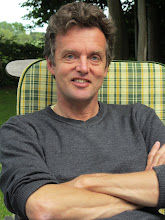
MY MUM
I visited my mum while I was in the U.K. on my walking tour. Now aged 84, she still lives in Derby in the semi-detached house she bought in 1958, just before I was born. She does everything herself, with the exception of a nice man who comes for a couple of hours every fortnight to look after the garden. Her apple trees and rhododendrons were looking particularly nice.
Since I was last there, she has had bits and pieces done on the house. A crumbling chimney, the wooden bits under the roof and above the windows, new gutters, leaking brickwork in the garage. She has also replaced the asphalt driveway and garden path with coloured paving stones, which have spruced things up. That's a good thing, since she may have to sell the house soon and move into a bungalow. Stairs are not the best of things once you get past 80.
As ever, she plied me with large helpings of some of my favourite foods (see Grandmothers' Cooking, 17/4/10). We had roast lamb with home-made mint sauce, strawberry flan, scones, chocolate mini-rolls and digestive biscuits. It was terrific. And I went to sleep in my childhood bed, solidly as always.
She is finding the world a strange place these days, full of weird happenings, an absence of tolerance, and too much "me, me, me". But some things never change, and she still plays the piano beautifully. The hands may be mottled, the wrists and fingers slightly stiff, the eyesight failing. But the tone, the touch and the technique are all still there, the result something wonderful and timeless.
She asked me this time if there was any furniture from the house that I would like to have if and when she goes. Only the piano, I said; it would be enough.
Walter Blotscher
Monday, 14 June 2010


Sunday, 13 June 2010
KOSOVO
When is a country not a country? That sounds a bit like a riddle from the Hobbit, but for Kosovo the issue is a bit more serious.
Yugoslavia was cobbled together after the First World War as a combination of six republics; Slovenia, Croatia, Bosnia, Macedonia, Montenegro and Serbia. Serbia had the added complication of two autonomous regions within its borders; Vojvodina in the north, added as part of the dismembering of Hungary, and Kosovo in the south. Both of these regions were dominated by non-Serbs; ethnic Hungarians in Vojvodina and ethnic Albanians in Kosovo, who made up 90% of the population. Kosovo had the further wrinkle that it included the site of Serbia's most famous historical site; the battlefield of a mediaeval slugfest against the Turks, which the Serbs in fact lost. Imagine the Brits wishing to hold onto the Calais enclave because the Battle of Hastings had been fought there.
After the Cold War, Yugoslavia gradually - and very painfully - split up into its six constituent parts. The Albanians in Kosovo naturally wanted the same, but for Serbia this was a split too far. After severe repression, NATO forces intervened, bombing Serbia until they stopped. In 1999 Kosovo was placed under a U.N. protectorate. Then in 2008, after a period of - for the Balkans - relative calm, Kosovo unilaterally declared independence.
Does that mean that it is a country? Well, yes and no. More than 60 countries have recognised Kosovo, including the U.S., Britain, France and Germany. But a fair number of others have not. They include two permanent members of the U.N. security council (China and Russia, the latter bound by historical ties to Serbia), India, and five members of the European Union. Romania and Slovakia have Hungarian-minority problems of the kind that could flare up in Vojvodina, Greece is still upset about Macedonia's name, and Cyprus remains a divided island. But the biggest naysayer is Spain, worried that regional separatist movements in Galicia, Catalonia and especially the Basque Country could lead to the crumbling of one of the E.U.'s bigger states.
Kosovo's unilateral declaration has been referred to the International Court of Justice in the Hague. However, because of the balance of political forces in favour and against, any ruling is unlikely to be definitive. Kosovo's final legal status remains in limboland.
This clash between legal niceties and political realities has lessons for other would-be countries. Palestine, Taiwan and Cyprus all spring to mind; plus southern Sudan. There is no obvious answer to the riddle above.
Walter Blotscher
When is a country not a country? That sounds a bit like a riddle from the Hobbit, but for Kosovo the issue is a bit more serious.
Yugoslavia was cobbled together after the First World War as a combination of six republics; Slovenia, Croatia, Bosnia, Macedonia, Montenegro and Serbia. Serbia had the added complication of two autonomous regions within its borders; Vojvodina in the north, added as part of the dismembering of Hungary, and Kosovo in the south. Both of these regions were dominated by non-Serbs; ethnic Hungarians in Vojvodina and ethnic Albanians in Kosovo, who made up 90% of the population. Kosovo had the further wrinkle that it included the site of Serbia's most famous historical site; the battlefield of a mediaeval slugfest against the Turks, which the Serbs in fact lost. Imagine the Brits wishing to hold onto the Calais enclave because the Battle of Hastings had been fought there.
After the Cold War, Yugoslavia gradually - and very painfully - split up into its six constituent parts. The Albanians in Kosovo naturally wanted the same, but for Serbia this was a split too far. After severe repression, NATO forces intervened, bombing Serbia until they stopped. In 1999 Kosovo was placed under a U.N. protectorate. Then in 2008, after a period of - for the Balkans - relative calm, Kosovo unilaterally declared independence.
Does that mean that it is a country? Well, yes and no. More than 60 countries have recognised Kosovo, including the U.S., Britain, France and Germany. But a fair number of others have not. They include two permanent members of the U.N. security council (China and Russia, the latter bound by historical ties to Serbia), India, and five members of the European Union. Romania and Slovakia have Hungarian-minority problems of the kind that could flare up in Vojvodina, Greece is still upset about Macedonia's name, and Cyprus remains a divided island. But the biggest naysayer is Spain, worried that regional separatist movements in Galicia, Catalonia and especially the Basque Country could lead to the crumbling of one of the E.U.'s bigger states.
Kosovo's unilateral declaration has been referred to the International Court of Justice in the Hague. However, because of the balance of political forces in favour and against, any ruling is unlikely to be definitive. Kosovo's final legal status remains in limboland.
This clash between legal niceties and political realities has lessons for other would-be countries. Palestine, Taiwan and Cyprus all spring to mind; plus southern Sudan. There is no obvious answer to the riddle above.
Walter Blotscher
Saturday, 12 June 2010
BOILED EGGS
The world is divided into two kinds of people. Those who slice the top off their boiled eggs, and those who bash it and pick off the bits.
My mother was a slicer. When we had boiled eggs for breakfast, she would solemnly slice the tops off her three children's eggs, before sitting down to her own. It was always done with a bit of a flourish, like a fencer with an epee. The advantage was that there were never any bits of shell in the yoke; the disadvantage was that she sometimes cut too low, so there was less room for me to dip my "soldiers".
Despite - or perhaps because of - maternal instruction, I have always been a basher. I like that first bash, when the spoon cracks the shell. And the challenge of picking off the surrounding bits without burning your fingers. You then prise open the top, put in some salt, and off you go.
When all is finished, I put the bits back in the empty shell and then put the whole thing in the bin. All of my family think that this is a disgusting habit, but I can't see why. Must be some Danish thing.
Walter Blotscher
The world is divided into two kinds of people. Those who slice the top off their boiled eggs, and those who bash it and pick off the bits.
My mother was a slicer. When we had boiled eggs for breakfast, she would solemnly slice the tops off her three children's eggs, before sitting down to her own. It was always done with a bit of a flourish, like a fencer with an epee. The advantage was that there were never any bits of shell in the yoke; the disadvantage was that she sometimes cut too low, so there was less room for me to dip my "soldiers".
Despite - or perhaps because of - maternal instruction, I have always been a basher. I like that first bash, when the spoon cracks the shell. And the challenge of picking off the surrounding bits without burning your fingers. You then prise open the top, put in some salt, and off you go.
When all is finished, I put the bits back in the empty shell and then put the whole thing in the bin. All of my family think that this is a disgusting habit, but I can't see why. Must be some Danish thing.
Walter Blotscher
Friday, 11 June 2010
INGERLAND
Ingerland is a rather strange country. For a start, it seems to be almost entirely populated by men, and not very attractive ones to boot. They generally wear either extremely tight-fitting white T-shirts, or no shirt at all. They have large beer bellies, and lots of aggressive tattoos, and they demonstrate a fashion sense, which in my youth was called "builder's bum". Their underlying skin tone is generally white, but exposed areas can often be bright pink. I sometimes wonder if they use body paint.
Ingerlanders quite obviously have a deep cultural heritage, since they are always singing local folksongs. However, I have not managed to learn many words of their language, since most of the songs seem to consist principally of the one word Ingerland. Maybe I am just getting old.
I tend to see Ingerlanders every four years or so, when the football World Cup is on. Is that just a coincidence? I think it must be, since no Ingerlander looks remotely suited to playing serious football. Perhaps if I knew more words, I could ask them.
Walter Blotscher
Ingerland is a rather strange country. For a start, it seems to be almost entirely populated by men, and not very attractive ones to boot. They generally wear either extremely tight-fitting white T-shirts, or no shirt at all. They have large beer bellies, and lots of aggressive tattoos, and they demonstrate a fashion sense, which in my youth was called "builder's bum". Their underlying skin tone is generally white, but exposed areas can often be bright pink. I sometimes wonder if they use body paint.
Ingerlanders quite obviously have a deep cultural heritage, since they are always singing local folksongs. However, I have not managed to learn many words of their language, since most of the songs seem to consist principally of the one word Ingerland. Maybe I am just getting old.
I tend to see Ingerlanders every four years or so, when the football World Cup is on. Is that just a coincidence? I think it must be, since no Ingerlander looks remotely suited to playing serious football. Perhaps if I knew more words, I could ask them.
Walter Blotscher
ONE MAN WENT TO MOW (2)
Typical. I go away for ten days, and when I get back, the grass on our lawn is halfway to emulating a Brazilian rainforest. It has apparently rained a lot recently here in Denmark; but even so, the growth rate was impressive. No prizes for guessing what I'll be doing for the next few days.
You may be wondering why none of the other inhabitants chez Blotscher did anything about it. Notably my elder son, who is currently at home, in-between national service in the army and going off to university. Mm, I had exactly the same question .....
Walter Blotscher
Typical. I go away for ten days, and when I get back, the grass on our lawn is halfway to emulating a Brazilian rainforest. It has apparently rained a lot recently here in Denmark; but even so, the growth rate was impressive. No prizes for guessing what I'll be doing for the next few days.
You may be wondering why none of the other inhabitants chez Blotscher did anything about it. Notably my elder son, who is currently at home, in-between national service in the army and going off to university. Mm, I had exactly the same question .....
Walter Blotscher
THEO WALCOTT
You have to have sympathy for Theo Walcott. Picked as an unknown 17-year old for the last World Cup four years ago, he didn't play a single game. Now an established member of Premier League side Arsenal, he was the most high-profile casualty when England team manager Fabio Capello reduced his squad from 30 to the final 23.
England have had a mixed run-in to the tournament. After qualifying with something to spare, they have stumbled in recent weeks, both on and off the pitch. Capello didn't listen to my advice (see Playing Away From Home, 4/2/10), but sacked captain John Terry for extra-marital infidelity. His replacement Rio Ferdinand - hardly a saint in my view, but that's neither here nor there - then tore knee ligaments in one of the final training sessions in South Africa, and is out for the tournament. And star striker Wayne Rooney is already being tipped by referees as one of the players most likely to be sent off, for dissent or bad tackling or both.
Most worryingly, England are trying to win the World Cup with a squad that has the highest average age of all the 32 teams (though it came down a bit when Ferdinand was replaced by someone younger). The pundits seem to think that they can definitely make the quarter finals, and possibly the semis. I am not so sure.
My tip to win? My heart says Holland, but my head says Spain, the current European champions. They warmed up with a 6-0 demolition of Poland, which was pretty impressive.
Walter Blotscher
You have to have sympathy for Theo Walcott. Picked as an unknown 17-year old for the last World Cup four years ago, he didn't play a single game. Now an established member of Premier League side Arsenal, he was the most high-profile casualty when England team manager Fabio Capello reduced his squad from 30 to the final 23.
England have had a mixed run-in to the tournament. After qualifying with something to spare, they have stumbled in recent weeks, both on and off the pitch. Capello didn't listen to my advice (see Playing Away From Home, 4/2/10), but sacked captain John Terry for extra-marital infidelity. His replacement Rio Ferdinand - hardly a saint in my view, but that's neither here nor there - then tore knee ligaments in one of the final training sessions in South Africa, and is out for the tournament. And star striker Wayne Rooney is already being tipped by referees as one of the players most likely to be sent off, for dissent or bad tackling or both.
Most worryingly, England are trying to win the World Cup with a squad that has the highest average age of all the 32 teams (though it came down a bit when Ferdinand was replaced by someone younger). The pundits seem to think that they can definitely make the quarter finals, and possibly the semis. I am not so sure.
My tip to win? My heart says Holland, but my head says Spain, the current European champions. They warmed up with a 6-0 demolition of Poland, which was pretty impressive.
Walter Blotscher
THE LAKE DISTRICT
I haven't blogged yet this month, since I have been in the U.K. on my annual walking holiday in the Lake District. Because of the hills, it is almost impossible to get an internet or mobile phone connection (though some of the more dedicated members of the group immediately open their Blackberries when they get to the top of a suitable peak). It has in fact been nice to get away from the daily electronics round.
Up to seven friends from University go on this trip, and this year's was the ninth, with everyone present. It always takes place during the summer half-term, as two of us are teachers. We meet in Lancaster on the Wednesday evening, travel to the Lakes for three days of walking, and return on the Sunday morning. At our age (50+), three full days is just about the right length of time.
This year we stayed in the Little Langdale valley at the Three Shires Inn, the meeting point of the three old counties of Westmoreland, Cumberland and Lancashire. The valley is beautiful, and we had some great walks in perfect sunshine. The weather has been fantastic for each of the last 5-6 years, so we were all expecting a drenching this time. But there was no rain. In fact, there had been no serious rain since last November, and the hills were the driest I have ever seen them. Many of the streams had no water in them at all.
The day of our arrival was marred by the news that a lone gunman had shot and killed 12 people in the area, and wounded a further 25, before committing suicide. Some of the killings (eg his twin brother and solicitor) were targeted, but many were random victims. A fair proportion of the local people were in shock.
Our party had its own horror story. Nobody fell down a ravine or sprained an ankle. But at the top of Bow Fell, as we stopped for lunch on the second day, I took off my T-Shirt and showed the others my cycling bib shorts. This created such frissons of revulsion and panic in the group that I had to get dressed again in a hurry. In vain did I tell them that all serious cyclists wear them, they were not convinced. But at least it gave us something to talk about on the way back down.
Walter Blotscher
I haven't blogged yet this month, since I have been in the U.K. on my annual walking holiday in the Lake District. Because of the hills, it is almost impossible to get an internet or mobile phone connection (though some of the more dedicated members of the group immediately open their Blackberries when they get to the top of a suitable peak). It has in fact been nice to get away from the daily electronics round.
Up to seven friends from University go on this trip, and this year's was the ninth, with everyone present. It always takes place during the summer half-term, as two of us are teachers. We meet in Lancaster on the Wednesday evening, travel to the Lakes for three days of walking, and return on the Sunday morning. At our age (50+), three full days is just about the right length of time.
This year we stayed in the Little Langdale valley at the Three Shires Inn, the meeting point of the three old counties of Westmoreland, Cumberland and Lancashire. The valley is beautiful, and we had some great walks in perfect sunshine. The weather has been fantastic for each of the last 5-6 years, so we were all expecting a drenching this time. But there was no rain. In fact, there had been no serious rain since last November, and the hills were the driest I have ever seen them. Many of the streams had no water in them at all.
The day of our arrival was marred by the news that a lone gunman had shot and killed 12 people in the area, and wounded a further 25, before committing suicide. Some of the killings (eg his twin brother and solicitor) were targeted, but many were random victims. A fair proportion of the local people were in shock.
Our party had its own horror story. Nobody fell down a ravine or sprained an ankle. But at the top of Bow Fell, as we stopped for lunch on the second day, I took off my T-Shirt and showed the others my cycling bib shorts. This created such frissons of revulsion and panic in the group that I had to get dressed again in a hurry. In vain did I tell them that all serious cyclists wear them, they were not convinced. But at least it gave us something to talk about on the way back down.
Walter Blotscher
Subscribe to:
Posts (Atom)